Good Morning everyone! I just have a single image to share today for monochrome Monday, as trying to export this one was an immensely frustrating process. I’ve been working with the new On1 Photo Raw 2019, and there are some serious export issues with the program. In reading some online forums, it seems to be an issue that a lot of people are having.
It took me 5 tries to export this image and have it resemble the image on my screen. The first was incredibly dark, a second version very light, one version everything was tinted red. I wish I would have saved all these junk exports to share, but I deleted them in frustration.
At this stage, I am actually contemplating switching up my workflow again and going back to Lightroom, as I really don’t like wasting a bunch of time doing things over and over again. So far there have not been any updates to the program that have addressed these issues.
This image was shot at Joshua Tree National Park in California, back in October. I was playing around with an infrared filter that I had purchased. I have much to learn about properly shooting with this filter, but I am happy with the result I got.
Last week I decided I would play around with one of the new features in Luminar, a filter called AI Sky Enhancer. Perhaps the timing wasn’t so good though, as yesterday evening I downloaded the newly release Luminar 3, and with the added library function, I was having a bit of trouble navigating the system (since I haven’t yet looked at any resources on how to use the new software). Despite a bit of floundering within the libraries function, the actual photo editing and filters layout remains the same, and I was able to complete my self-appointed task.
This first image wasn’t solely about the sky; it’s kind of hard to ignore the leopard in the tree! I wanted to enhance the natural colours of the sky and bring up some of the shadow areas. I started with the AI Sky Enhancer and added other filters as needed (which was how I approached all the images). I’ve included a split screen showing before and after and the edited image for each one I worked on.
Next up is a photo shot while on a boat on the Boteti River in Botswana. Shooting into the sun left the sky quite washed out; I am impressed how well I could enhance the sky colour and the clouds with Luminar without it becoming to HDR-like.
The Okavango Delta is an amazing place for sunsets; the colours in the sky are incredibly dramatic from my experience. With that much colour already, it is easy to take the image a step too far and have it look radioactive. The AI sky enhancer did a great job accentuating the detail in the clouds, without pumping the colour up to 11.
Finally I have included a sunset from the Hoanib desert in Namibia. There was a lot of airborne dust and sand that evening, so while I did do some noise reduction in the sky to reduce the visible grain, there is definitely still a lot of texture. This was also shot with my Panasonic camera, which is much noisier than the Nikon I was also shooting with. Regardless, I am please with the realistic tones, the detail in the clouds and the textures in the desert and the hills.
I’m going to ow have to spend some time familiarizing myself with the layout of the new Luminar software, so I can work using their library function in an efficient manner.
This week, I felt inspired to play around in Topaz Impressions and create some of my artistic impression images. Or as I like to say, what I would paint, if I could paint :).
Next week, I am going to try and work with the new AI Sky Enhancer that Luminar just released.
Wishing everyone a fantastic week ahead!
A young elephant seen on an early morning game drive.A leopard scanning the horizon at sunset in the Okavango Delta.A regal lion laying in the tall grass just after sunrise.A large warthog moving through camp.A fiery sunset – Africa has the most expressive skies!
While I had the opportunity to edit and share images from my night sky workshop in October and some older images as well, I didn’t actually have the chance to get out and shoot the night sky in November, so I guess the topic of the month was a bit of a fail. There is always another night to get out, and now that we are into the very short days of winter, I don’t have to stay up too late to do so. Fingers crossed I can get out and get some local images…. maybe even some aurora shots if the stars line up 🙂
What’s new this month?
I’ve come to the realization this month that in 2018 I’ve done some really deep dives into editing in lots of different ways, but I’ve really not spent much time out shooting, which feels like a real missed opportunity, and something that I need to amend moving into 2019. When I do get out with my camera I quickly get into the zone and find it such an enjoyable activity, that I really need to prioritize it more.
5 favourites – November
What’s coming up next?
I’ve decided not to have a specific topic of the month in December. The month always slips by in such a whirlwind of activity and family time that I would rather just share when I can, and explore what interests me at a given moment, than trying to fit into a specific topic. I’m also going to spend some time thinking about topics and projects for 2019, which is coming up so soon.
Mother Nature has certainly not been cooperating with my plans to get out and shoot at night. While I still have images from Joshua Tree that I would like to work through, I thought I would switch it up this week and edit some old images instead.
This image was shot at Green Lake in Whistler BC. I was in the area for a multi-day wedding celebration, and set up my camera to take images to create a star trail while I sat around a fire drinking beer and enjoying the company of good friends. This was done with my first DSLR camera, a Nikon D5100. I still think I am pretty lucky that I didn’t tumble into the lake when I went to collect my tripod later in the evening 🙂I’ve not kept up to date with it recently, but in the past I have tried checking in with a northern lights forecasting site, and if the forecast is good and the weather clear, I’d head out and with my camera and see if I could see anything. The lights were very faint on this night, but I think the combination of the faint purple glow and the warm tint to the clouds from highway lights in the distance looks pretty.The best evening I have viewed northern lights I saw a proton arc form and dissolve over about a half hour period… all from my driveway. The milky way appears faintly above as well.The proton arc as it was forming.A beautiful combination of magenta and green.No northern lights in this one, just a starry sky enhanced by some whispy clouds illuminated by the rising moon.
The weather this week wasn’t conducive to getting out and shooting at night, so I have worked through a few more of my images from Joshua Tree. When editing, one of the things the workshop instructor mentioned really stuck with me, and that is to really watch the saturation of star images. I really tried to keep things as natural as possible, although it can be fun to crank things up to 11 and see what happens 🙂 Maybe next week.
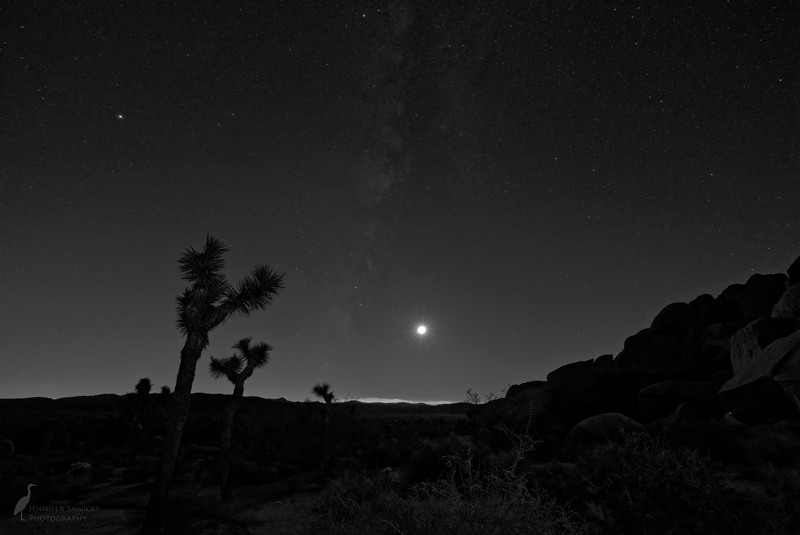
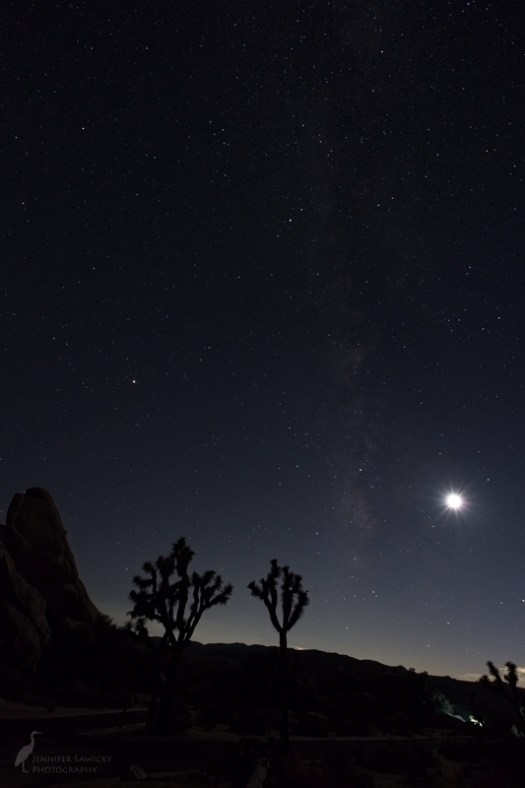
Planes overhead and lots of traffic heading for the park gates after the sun went down.The milky way rising over the Joshua trees.What are your thoughts on night sky images in black and white? I really like them personally, although there is a real risk of the image being way too dark.
While I was shooting with my main camera, I had set up my Panasonic camera on the hood of my car with a gorilla pod, and set it to take a series of images to make into a time lapse later. It didn’t turn out quite as planned, but I’ve included it here as it shows all the traffic from the parking lot, as well as other photographers. Since I was doing a time-lapse series, I didn’t have the long exposure noise reduction turned on, and I think the still images from the Panasonic really would have benefitted from having that done in camera.
This was the last shot I captured while my camera was set in time lapse mode.
For this week I worked on a few images from my time in California. Compared to my trips to Africa, I took relatively few photos, but I have a good number that I am interested in playing around with to see what happens.
I spent a lot of time outside relaxing with my camera nearby in case any interesting birds popped into the yard, but found myself also being drawn to the beautiful shapes of the palm fronds.
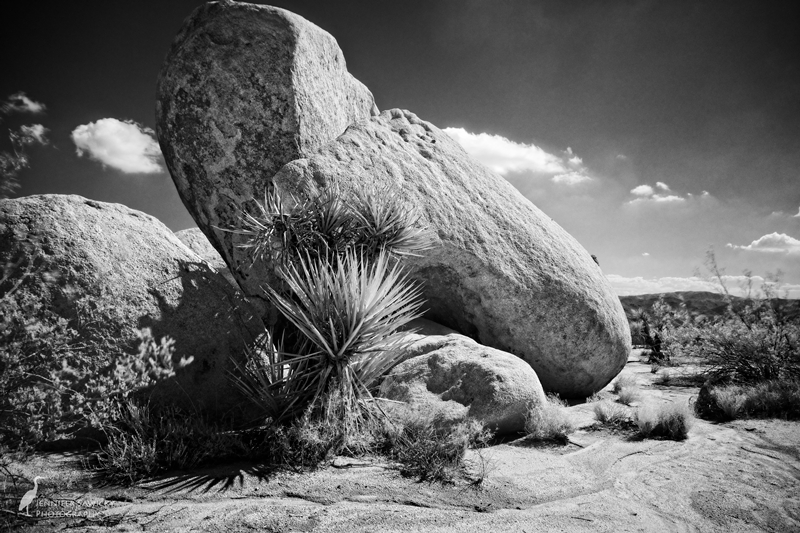
One of the things I picked up while away was an infrared filter for my camera, and I took it out and started playing around in Joshua Tree when my photo workshop was over. I have so much to learn about all the nuances of infrared photography, but even without doing the proper things, like setting a custom white balance, I am still happy with what I was able to come up with when converting the images to black and white.
I wish I would have written down which of the stops through the park this was; I was drawn to the wonderful boulders and all the desert plants and cacti that surrounded them.
I decided on the topic of the night sky for November, mostly because I spent an evening during my holiday at Joshua Tree National Park at a night sky photography workshop, and I have images I want to work through. Also, November may have some potential for night sky photos at home (since it isn’t too bitterly cold yet, and night is falling quite early, which is good for an early bird like me).
Just getting to the workshop proved to be quite an adventure. The night before, a rare thunderstorm rolled through the desert with heavy rain, and there were a lot of road closures due to small local mudslides. In the town of Joshua Tree, the main highway through town had over 6 feet of mud (and a buried Mini Cooper car) in the middle of the highway. When setting off in the morning, I headed toward the Cottonwood gate, planning to head up to the Oasis visitors centre through the park, but that gate turned out to be closed (and would remain so for several days to get everything cleaned up). Then there was a substantial backtrack to get back on the interstate and head to the other gate in Twentynine Palms, but through there I encountered more detours and terrible road conditions. I made it there in the end, albeit rather late and after the class had already started.
I headed back Sunday morning for the second part of the workshop, by then the main highway through the town of Joshua Tree had reopened. These are just some of the huge piles of mud that had been plowed along the side of the road.
Despite the crazy weather the night before, and threats of potential storms during the day of the workshop, the weather couldn’t have been more beautiful, with clear skies and just a few wispy clouds leftover. Besides the driving conditions to get to the park, the other downside to the weather was as the evening cooled, there was a lot of moisture still in the air, causing dew to form. I wasn’t worried about my camera (some of the people that were local, and not used to the moisture that I am, were quite alarmed) but it did mean that images started to appear soft and fuzzy later in the evening. Everyone packed up by about 9:30, because by that point it became impossible to get any clear images. Looking through my images, I can see a definite deterioration in sharpness as the evening draws on, but I still like the images from later in the evening, despite the softness.
Here are a few of the shots I have edited so far. I haven’t broken the habit of working in multiple editors, so I have images done in all of my programs.
We were set up in a day-use only part of the park, so there were a lot of people packing up to leave as we were setting up and taking images. The headlights and taillights of the vehicles provided some light painting on the foreground (though not always hitting all the areas I would have liked!) Edited in On1 Photo Raw.A joshua tree illuminated by car headlights, edited in Luminar.People moving to and fro with headlamps and flashlights. Image edited with Topaz Studio.The last image I took in the evening, with the milky way faintly decorating the sky and a plane moving through the scene.